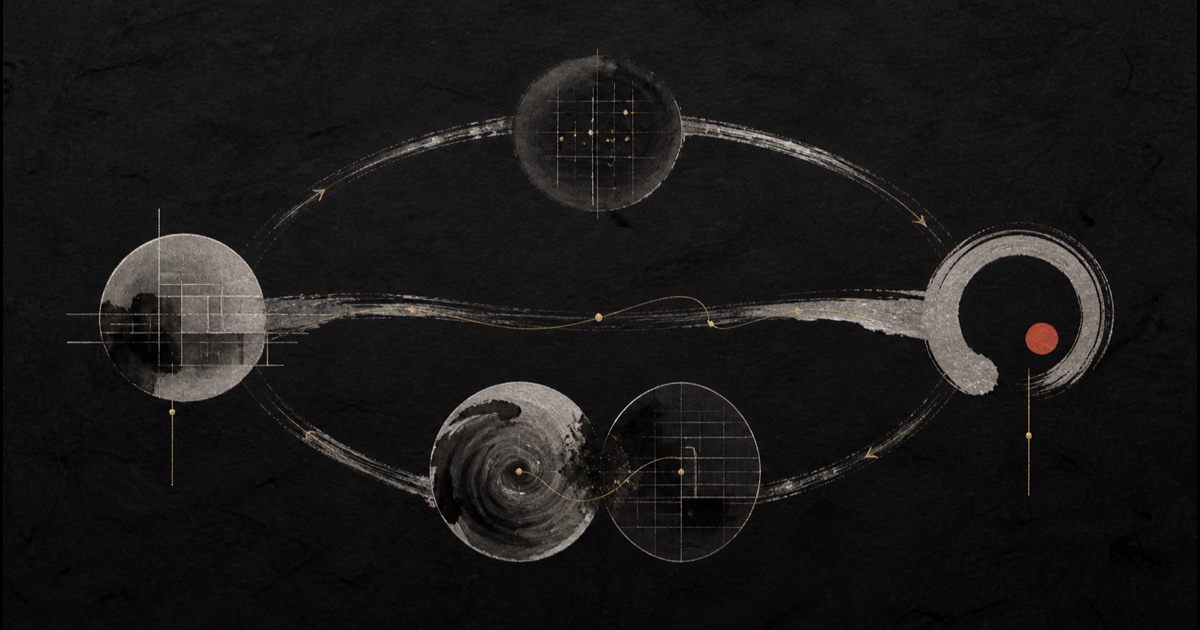
What I want from Loop Engineering is not a roomful of AIs holding a meeting that never ends. The point is to separate the goal, the work, the judgment and the human authority behind the system. It may keep working, but at important points it has to stop, show enough evidence and leave the next step as a choice that can still be made.
The structure begins with a Goal set at the outset. Orchestration breaks it into milestones. Labor does the work. Judges decide whether a milestone has actually been reached. Scrum checks and adjusts the plan when needed. Every 24 hours, the system must pause and issue a report so that a person can choose whether to continue, replan or stop.
The important word here is not "loop." It is the separation of powers inside the loop. The part that sets a task cannot simply declare that the task is complete, and the part that performs the work cannot pass on its own account alone.
Set the Goal first. Let Orchestration decompose it
A person sets the Goal at the beginning. It is not a slogan that the system may reinterpret whenever convenient. It is a versioned contract. Orchestration may change the route, divide the work and reorder tasks, but it may not quietly replace the final objective with an easier one.
Each milestone should state its success conditions, required evidence, resource budget and escalation rules. Only then is Orchestration doing scheduling rather than writing the exam and grading it at the same time.
Labor delivers work, not "I am done"
The Labor layer does the work. It may write code, run tests, organize data or produce a report, but what it submits must be something another layer can inspect. A summary can make the material easier to read. It cannot stand in for the evidence.
This boundary matters because a system can easily mistake fluent language for progress. A complete-sounding answer is not the same thing as an engineering result that exists and can be checked.
Two AI Judges decide independently before they meet
There should be more than one Judge. Two AIs can review the same milestone from different directions. One asks whether the evidence is sufficient and the result reproducible. The other looks for counterexamples, risk, rollback gaps and drift away from the Goal.
They form their conclusions independently so that neither anchors the other. Then they exchange their strongest objections and decide whether to revise their judgments. Coupling does not mean letting two AIs talk to each other from the start. It means allowing independent judgments to collide afterward. Agreement can release the next step. A limited disagreement can move to Scrum with conditions. A large disagreement goes straight to a person.
The Judge answers one question: was the milestone reached? Scrum answers another: given that judgment, should the system continue, redo the work, replan or escalate to a person?
Scrum is a review point, not a perpetual-motion machine
Scrum does not need to run continuously. It is closer to a control point triggered by conditions. Check when a milestone is completed, when a task fails repeatedly, when outside information changes or when a person asks to intervene.
If the work is moving steadily and there is no new judgment to act on, Scrum should stay quiet. The purpose of the loop is not to manufacture activity. It is to make the necessary adjustment at the right moment.
After 24 hours, the authority to continue returns to a person
However autonomous the system becomes, it must stop every 24 hours and report the current Goal version, completed milestones, the Judges' decisions and raw evidence, resources consumed, open risks and the proposed next step.
This is not routine reporting. It is a request for renewed authority. A person may continue, revise, roll back or terminate the work. Nor does the system have to wait for the full 24 hours. High-risk operations, a budget overrun, conflicting goals, repeated failure or a serious disagreement between the Judges should trigger the same pause early.
Loop Engineering is not an attempt to engineer how busy an AI system can become. It is an attempt to engineer the moment when an autonomous system must stop and admit that it needs an outside judgment.
The architecture in one paragraph
Loop Engineering keeps a human-set Goal as the boundary. Orchestration decomposes and schedules the work. Labor executes it. Two AI Judges make independent assessments and then review each other's objections. Scrum checks and adjusts the plan only when necessary. A human checkpoint, no more than 24 hours away, renews or withdraws the authority to continue.
Illustration of a milestone review
The loop does not run away on its own. It waits for a review point.
Check whether the artefacts, tests and evidence are sufficient to support the milestone.
Search for counterexamples, rollback gaps and hidden Goal drift.
Twenty-four hours is only the maximum authorisation window. The system should pause sooner when it encounters high risk, repeated failure, a budget overrun or excessive disagreement between Judges.