The conclusion first
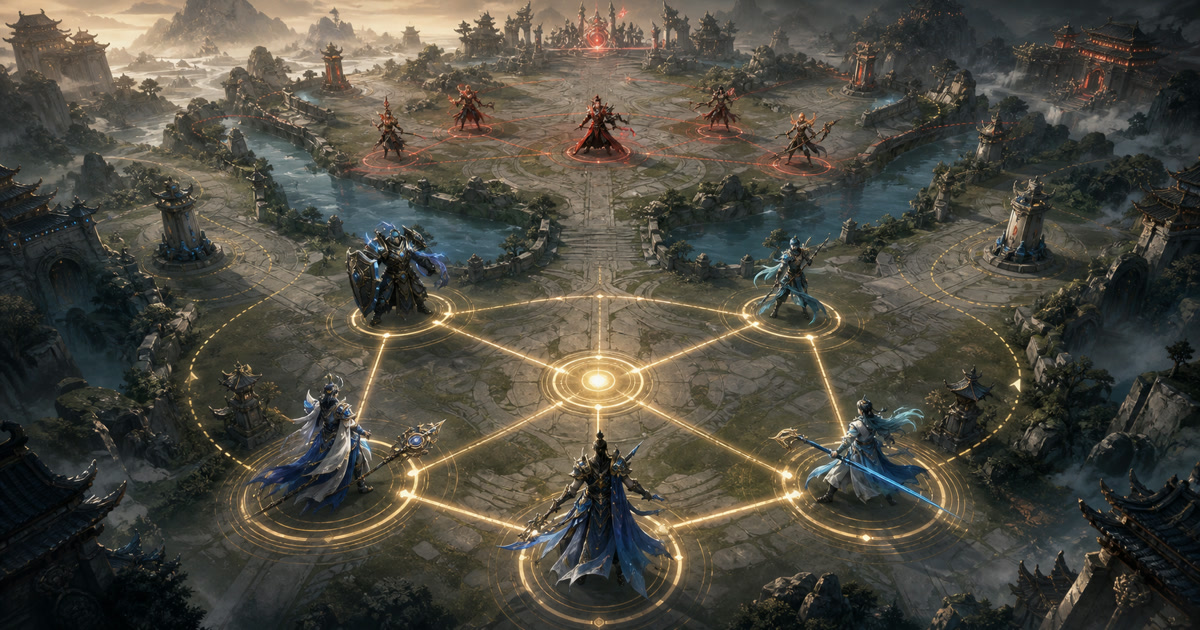
A five-stack is not simply the sum of five hidden ratings. To a matchmaking system, a fixed team of five looks more like a super-player with internal relations.
Its effective strength is roughly:
A premade team with a lower average hidden rating but long experience together may therefore face opponents with greater individual skill. If the system expects an even match, the arrangement need not be punishment for a win streak. It may simply be pricing the advantage supplied by communication and coordination.
The most effective responses for a five-stack are equally clear:
- Keep the members and roles stable so that real synergy can continue to grow.
- Prepare at least two complete compositions instead of letting all five players take only their favourite heroes.
- Allow only one person to make the final call, with rules for resources and retreat agreed in advance.
- Make the stopping condition a team rule. Do not let one tilted player drag the other four into another match.
Solo queue is mainly about reducing personal variance. A five-stack is about managing team structure. Five strong players do not automatically form a strong team.
This is the second sequel to Who Is the System Optimising?. The previous essay set out the general profit-first framework. This one deals only with five-stacks: when five people enter the queue as one unit, how might the system understand that team, and how should the team respond?
The system calculates individuals first, then their relations
Let five-stack \(A\) contain five players with individual hidden ratings \(\mu_1\) through \(\mu_5\). The team’s effective strength can be written as:
Here, \(\psi_A\) is historical synergy, \(\chi_A\) measures role, hero and composition fit, and \(D_A\) is the cost imposed by skill gaps and internal weaknesses.
Consider a purely illustrative example. Team A has an average hidden rating of 1500. Long practice together adds 60 points of synergy, while a role conflict subtracts 20:
Team B averages 1530 and has stronger individuals, but it has only just formed and receives 10 points of synergy:
The system may predict a fifty-fifty match. Team A sees only that the opposing players have higher average ratings and may easily interpret the match as punishment for being a fixed team.
TrueSkill estimates personal skill and uncertainty. Dynamic K determines how quickly a player’s rating changes after a result. A five-stack also needs a separate team-synergy rating:
\(S\) is the actual outcome, and \(P\) is the system’s predicted win probability. If a team given only a 30 per cent chance wins, the result shows that the old model underestimated it. The individual ratings, the synergy rating or both should rise.
After a fixed five-stack keeps winning, normal updates to hidden ratings and synergy will make its opponents stronger even without Handicap.
Five players create ten relationships
Among five players there are:
pairwise relationships.
A GNN can treat players as nodes and shared parties or matches as edges. It can learn which combinations perform better. It may identify a fixed mid-jungle pair, marksman-support coordination, the core of the team, and what changes when one member leaves.
PCA can compress individual behaviour into a smaller number of features such as demand for resources, preference for pushing, participation in team fights and role habits. A five-stack model must do more than average those features. It must also detect conflicts among them.
Five individually strong players may still form an unstable team if all require a large share of gold, all expect to deliver the final damage, or no one will handle the frontline and waves.
A relationship model can be wrong too. Strong players already prefer to team with other strong players, so a high historical win rate does not necessarily come from extra synergy. The system must control for individual ability and opponent strength before it can isolate the real value of cooperation.
How a profit model sees a five-stack
When a solo player leaves, the system loses one active user. When the central member of a five-stack leaves, the other four may stop with them.
The retention value of a five-stack therefore cannot be added up player by player. Expected retention for one candidate match can be written as:
Here, \(p\) is Team A’s win probability. \(R_A^{win}\) and \(R_A^{loss}\) are its predicted retention after a win and a loss.
EOMM predicts which match is most likely to keep both teams playing. Survival analysis estimates the risk that members leave or that the team dissolves. A GNN can also estimate who organises the group. MIQP or a faster combinatorial search selects the final opponent under constraints on skill, latency and party rules.
A profit-first objective can produce two opposite outcomes for a five-stack.
In one, a stable premade keeps playing after a loss. The system believes it can tolerate a harder match, and protecting it for one game adds little retention.
In the other, one captain’s departure would take four other players away. Protecting that central node has greater network value.
High spending, long play time or leading a large group cannot alone prove that the system protects or punishes a player. The question for the system is how much future activity and value a change to the next match will add.
Fast five-stack matchmaking requires a fast online model
In practice, a five-stack often enters a match quickly. The system is therefore unlikely to begin calculating the complete history of every player only after they press the button, then spend a long time searching for a theoretically perfect opponent.
A more plausible engineering design performs most complex computation offline. The system continuously updates individual hidden ratings, hero and role features, team synergy and retention states. When the five-stack enters the queue, the online layer reads those results and quickly chooses an opponent from the candidates currently available:
\(C(A)\) is the candidate set the system allows for Team A at that moment, \(R\) is effective team strength, and \(\psi\) is estimated synergy. Product rules or backend data would be needed to confirm how the candidate set is partitioned, whether complete five-stacks must face one another, and how broad a skill range is allowed.
Fast entry rules out at least one explanation. A complete team does not necessarily make the search slow. The system may have enough five-stacks online at once, use precomputed buckets and fast retrieval, or allow a broader candidate range. Queue speed alone cannot distinguish among these designs.
A complex model need not be slow online. PCA, GNNs, TrueSkill and survival models can generate player and team features in advance. Online matchmaking may need only table lookups, filtering and a fast optimisation, all of which can finish quickly.
Fast matchmaking therefore proves neither that the result is random nor that the teams were matched through an exquisitely detailed one-to-one comparison. It shows only that starting quickly carries high priority among the system’s constraints and that the opponent came from the solutions immediately available.
Information entropy can measure the uncertainty predicted for a match, but a predicted 50 per cent is not a true 50 per cent. A newly formed five-stack is especially prone to crushing wins or losses because the system knows the five individual players but not yet the strength of their combination.
Minimax can help manage that uncertainty. The system can look for an opponent that will not produce a severe imbalance even if the synergy estimate is wrong. Once the draft begins, the five-stack also faces genuine strategic counterplay. Opponents can ban a central hero, break a fixed composition and force the team to use its second plan.
The position of a five-stack
New teams have the highest variance
The system has a history for each player but too little history for the team. It must begin with a prior estimate of synergy and update it from results.
An early-stage team may therefore crush several opponents in a row or lose repeatedly. Those results contain individual skill, the process of learning the composition, and error in the system’s estimate.
A mature fixed team may face stronger opponents
As the system learns a team’s advantages in communication, shot-calling and composition, it raises the estimate of effective strength. Facing opponents with higher individual ranks does not automatically mean punishment.
If matchmaking always used only the average personal rating, a mature five-stack would retain a permanent advantage. Pricing synergy can itself be part of fairness.
Replacing one player changes the whole graph
Five players have ten pairwise relationships. Replacing one member directly changes four of them, as well as the role allocation, hero pool and shot-calling structure.
The impact of a temporary substitute is therefore usually larger than replacing one rating with an identical number. A strong new player can still weaken the team in the short term.
The wider the internal skill gap, the harder the match is to calibrate
One expert with four low-skill players cannot be represented adequately by an average. The expert may control the tempo, while opponents repeatedly attack a weaker member.
Looking only at the average can produce a stomp. Weighting the highest rating too heavily can give the whole team opponents it cannot handle. A five-stack with a large internal spread is inherently difficult to calibrate.
How five-stack players can respond
Keep the members stable, and keep the roles stable too
Keeping the same five people is only the first step. Each needs a stable primary role. The team must know who controls the early tempo, who receives the main resources, who manages waves, who initiates and who protects.
If the team fights over roles again before every match, it cannot reliably realise the synergy even if the system has estimated it correctly.
Prepare two complete compositions
A five-stack cannot be five people each taking one familiar hero. Prepare one standard plan and a second for when the central heroes are banned or countered.
The alternative must preserve the same functions: initiation, frontline, sustained damage, wave clear and pushing. Hero names may change. The work the team must perform cannot disappear.
Only one person can make the final call
The most common communication problem in a five-stack is not silence. It is five people shot-calling at once.
Decide in advance who makes the final decision in a critical moment, along with a few simple rules. Will the team fight before an objective spawns? What comes first after a won fight? Who calls the retreat?
That is more effective than arguing in the moment about which theory of play is correct. A five-stack’s real advantage is lower decision latency.
Design around the weak point instead of pretending it does not exist
The system may already see the skill gap within the team, and the opponent will notice it during the match. Stronger members cannot think only about taking every resource. They must consider how to prevent a weaker role from being broken repeatedly.
The composition should give the weak point enough wave clear, survivability or protection. Preventing two fatal mistakes is often worth more than giving the central player a little more gold.
Decide as a team when to stop
In a five-stack, the most tilted person often drives the decision to continue. One player says ‘one more,’ and the other four are pulled into the next match.
Before starting, agree on a maximum number of games or a losing-streak limit. Stop ranked play when someone is clearly tired, arguments begin, or a member refuses the agreed roles.
This is not emotional comfort. Real team synergy falls with the quality of communication, while the system may still match you against stronger opponents using your historical synergy.
Do not automatically interpret stronger opponents as punishment
Communication and composition have real value in a fixed five-stack. If the system offsets that advantage with stronger individual opponents, it is pricing the team’s ability.
Only a persistent overestimate or underestimate of team strength amounts to a miscalibrated model. One match against higher-ranked opponents shows only that the candidate pool and composite score produced that combination.
Do not treat spending as matchmaking leverage
When five people buy skins, join events or remain active together, the commercial value of the team may rise. That does not prove that the system will give it easier matches.
Spending should still follow individual budgets. Do not top up to purchase supposed protection, and do not use group spending to repair the emotion of a losing streak.
The most important principle for a five-stack
Solo queue gains its advantage from individual consistency. A five-stack gains its advantage from synergy. Matchmaking can learn that synergy and price it, but it can only chase what has already appeared in the data.
A team with stable members, clear roles, backup compositions and unified shot-calling may improve its real synergy faster than the model can estimate it for a time. Once the system raises effective strength and the opponents become harder, the team must continue improving its drafts and decisions rather than describing every difficulty as punishment.
This essay, too, is a structural deduction rather than a public description of Tencent’s production algorithm. Ten real methods provide the analytical toolkit: TrueSkill and Dynamic K update individual ability; PCA and GNNs describe team structure; EOMM and survival analysis predict whether the team continues; information entropy, Handicap and Minimax adjust or assess match difficulty; and MIQP produces the final combination. They can form such a system, but public evidence does not show that Honor of Kings implements the complete design.